Contrast became a legal issue in June 2025 — what the EAA actually requires
The European Accessibility Act has been enforceable since 28 June 2025. Here is what changed for color contrast, who is in scope, and a 30-day plan that does not require a redesign.
As of 28 June 2025, the European Accessibility Act (Directive (EU) 2019/882) is enforceable across the EU, and its technical conformance pathway pulls WCAG 2.1 Level AA into scope through the harmonized standard EN 301 549. The contrast ratio your designer has been quoting for years, 4.5:1 for normal text under WCAG 2.1 SC 1.4.3, is now an auditable requirement that national market-surveillance authorities can fine you for missing.
WebAIM's 2024 Million audit found low-contrast text on 79.1% of homepages, the most common accessibility issue on the web. Most of those sites now have an EU exposure they did not have in May.
What the EAA changed on 28 June 2025
The Act is not new. It was adopted in April 2019, and member states had until 28 June 2022 to transpose it into national law. What flipped in June 2025 is enforcement: from that date forward, national authorities can act on non-compliant products and services placed on the EU market. The EAA harmonizes the floor and adds private-sector services that previously sat out of scope.
For most product teams, the change is administrative. WCAG 2.1 AA was already the working spec for public-sector procurement in Europe. What is new is that a consumer-facing fintech app, an e-commerce checkout, or a SaaS dashboard sold to EU consumers is now on the same hook.
How WCAG 2.1 AA gets pulled in (the EN 301 549 hop)
The EAA does not name a contrast ratio in its own text. It points at EN 301 549, which currently incorporates WCAG 2.1 Level AA as the conformance baseline for digital products and services. WCAG 2.1 SC 1.4.3 sets the ratios:
- 4.5:1 for normal-size text
- 3:1 for large text (18pt, or 14pt bold and above)
- 7:1 normal and 4.5:1 large at the AAA level (not required by EAA, but a sensible target for body copy)
- 3:1 for non-text UI components and graphical objects (SC 1.4.11)
The thresholds are not rounded. A measured ratio of 4.49:1 fails AA. That precision matters for design systems where a brand color sits one or two ladder steps away from passing.
Who is actually in scope
The EAA targets B2C digital products and services. Illustrative scope covers consumer banking, e-commerce, e-books, ticketing, telecommunications, ATMs, computers, smartphones, and e-readers. If you sell something a consumer in the EU can buy or sign up for, you are very likely in.
The microenterprise exception is narrow: service providers with fewer than 10 employees and turnover at or below €2 million. It does not apply to product manufacturers.
Member-state transposition adds variation. Countries adapted the directive with their own complaint mechanisms and penalty structures, so two products on the same codebase can face different enforcement risk depending on which national authority handles a complaint.
Penalties, enforcement, and what auditors look at first
Enforcement runs through national market-surveillance authorities, and fines vary by country. Spain's transposition includes administrative penalties up to €1 million; Germany's framework allows fines up to about €3 million for serious infringements. Other member states sit somewhere in that range. None of these numbers are pinned to a published case yet, so the practical risk today is investigation, remediation orders, and reputational exposure rather than a marquee penalty.
Auditors look at what is easiest to measure first, and color contrast qualifies. A static analyzer can scan a rendered page, sample foreground and background pixels, compute the WCAG ratio, and flag every failing pair without human review. That is why low-contrast text is the most-cited issue in automated audits, and why a contrast pass is the cheapest defensive work you can do this quarter. Missing alt text, missing form labels, empty links, and unspecified document language round out the same sweep.
The US picture: ADA lawsuits and the contrast share
The US side moved in parallel during 2024 and 2025. ADA Title III digital-accessibility lawsuits have climbed every year for nearly a decade. By WCAGsafe's count, roughly 4,605 federal complaints were filed in 2024 and around 5,114 in 2025, a year-over-year rise of about 37%. AudioEye's tracking points the same direction.
Insufficient color contrast appears in roughly 68% of those 2025 complaints, the single most common technical citation, ahead of missing alt text, missing form labels, and empty interactive elements. The plaintiffs' bar has settled on contrast as the easiest claim to prove, because a screenshot and a hex code are evidence anyone can verify. A team that closes the contrast gap reduces EU regulatory risk and US litigation risk in one pass.
A 30-day compliance pass that does not require a redesign
You do not need a rebrand to clear the AA bar. Most sites audit out at 80 to 90% pass with a known set of repeat offenders. A focused month is usually enough.
Week 1, inventory and measure. Pull every foreground/background pair from your token map: body, headings, links, buttons, form fields, focus rings, placeholders, error states, on-light and on-dark surfaces. Most teams find 30 to 60 unique pairs. Run each through a free contrast checker and mark each as AA pass, AA fail, or AAA pass. The classic offenders are placeholder gray, secondary button labels, brand-500 links on white, and on-dark borders that drop below the 3:1 non-text threshold.
Week 2, fix at the token layer rather than the component layer. Move failing tokens to the next ladder step that clears the threshold for the surface they sit on; a blue-500 link at 3.68:1 on white moves to blue-700 at 8.59:1. Do this once in the token file and let the change propagate. Then rename tokens so the surface assumption is in the name (link-on-light, link-on-dark, placeholder-on-light). The next engineer who reaches for the wrong one feels the friction.
Week 3, automate the regression check. Add a CI step that runs an axe-core or pa11y scan on a sample of pages and blocks PRs that introduce new contrast failures. The scan catches the silent drift that is otherwise inevitable.
Week 4, document and sign off. Record the contrast ratio next to each token in your design-system docs (blue-700 / 8.59:1 on white) and publish an accessibility statement for your EU-facing surfaces. That statement is the artifact a market-surveillance authority will ask for if a complaint lands.
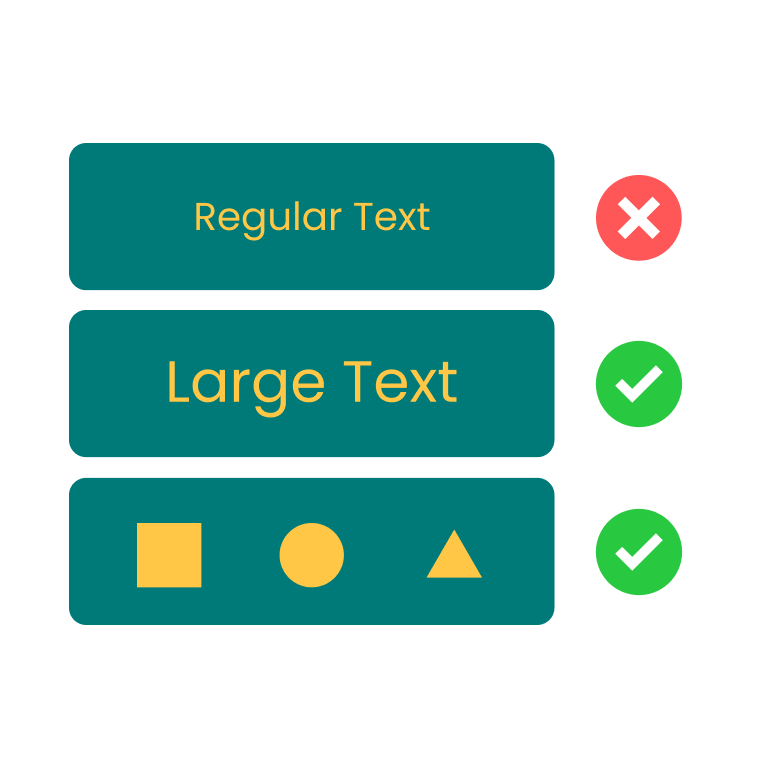
颜色对比度检测
检测文本与背景色是否符合 WCAG 无障碍标准
The token-map step is the largest win. Run your token pairs through the checker once, fix the failures at the source, and most downstream components inherit the fix without any per-component edits.


If you do one thing this week, run your link, body-text, and placeholder colors against your two most common backgrounds and write the four ratios on a Post-it. That measurement, and a willingness to nudge a brand shade two steps darker when it fails, closes most of the EAA contrast gap before any lawyer sends an email.
Color Contrast Checker · Z.Tools
Check WCAG accessibility compliance for text and background colors
- accessibility
- compliance
- eaa
- wcag
继续阅读
TTS in an accessibility plan: where it helps, where it stops
Adding text-to-speech to a website or app looks like an accessibility win. Sometimes it is. Sometimes it is a checkbox that distracts from the real accessibility work. Here is the honest map of where TTS helps and where it does not.
Live captions are not the same as accessible captions
Auto-generated captions look like an accessibility solution and usually aren't. Here is the difference between live captions and accessible captions, why ADA and WCAG care, and what good practice looks like in 2026.
Voice cloning from a few seconds of audio: where it works, where it stops, and consent
Voice cloning from three to ten seconds of audio is now in the AI text-to-speech tool. The technical limits, the legal limits in 2026 (Tennessee ELVIS Act, California AB 2602 and 1836, EU AI Act Article 50), and a consent workflow that holds up.